

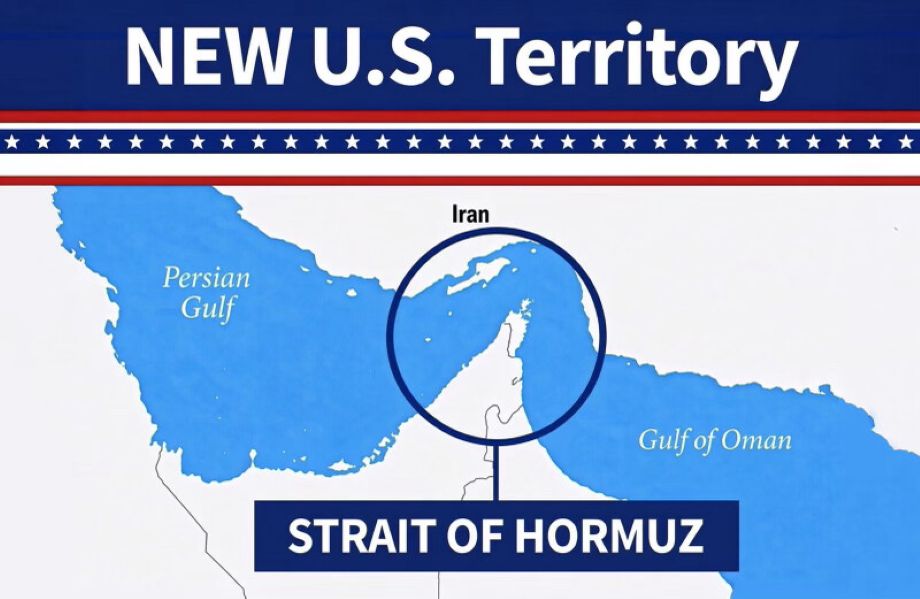
US President Donald Trump has intensified the confrontation with Iran by describing the strategically important Strait of Hormuz as “NEW US Territory” and repeatedly asserting that Washington has control over the key maritime route. The remarks come as tensions between the United States and Iran remain high and Tehran continues to reject Washington’s claims over the waterway.
Trump recently shared a map on Truth Social that labelled the Strait of Hormuz as a new US territory. He had earlier said during an August 14 event that he would soon declare the waterway US territory. The US president has also argued that American forces have control over the strait through a naval blockade.
Iran has strongly rejected the claim. Iranian officials maintain that the Strait of Hormuz remains under Iranian control and have disputed Trump’s assertion that the waterway is fully open and under US authority. Tehran has also linked the reopening of the strait to changes in US policy and the lifting of pressure against Iran.
The dispute has significant international implications because the Strait of Hormuz is one of the world’s most important energy corridors. Around one-fifth of global oil and liquefied natural gas shipments normally pass through the waterway, making any prolonged disruption a major concern for energy markets, shipping companies and importing countries.
The latest confrontation is also unfolding alongside Washington’s growing economic pressure on Tehran. US officials have threatened tougher sanctions against Iran, while Iranian Foreign Minister Abbas Araqchi has dismissed the threatened measures as a sign of desperation and argued that sanctions will not force Tehran to surrender its position.
The Strait of Hormuz has therefore become a central flashpoint in the wider US-Iran confrontation. Trump’s territorial language, Iran’s rejection of American control and continuing uncertainty over maritime movement have increased concerns about regional stability and the potential impact on global energy supplies.