


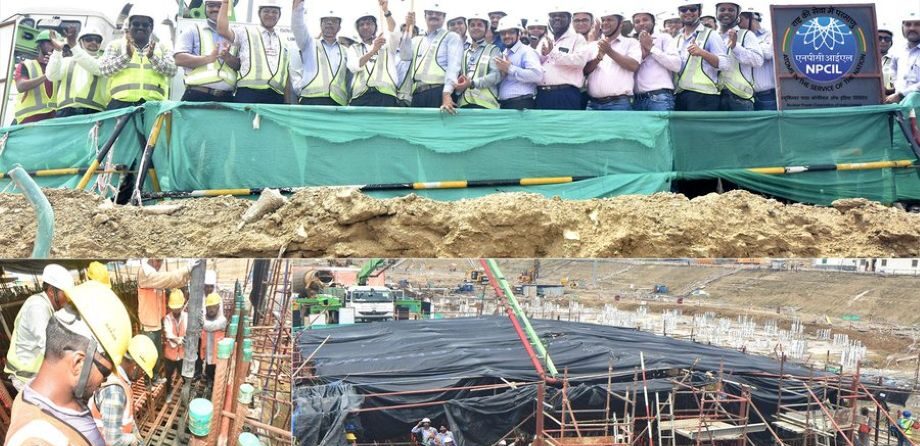
The Gorakhpur Haryana Anu Vidyut Pariyojana (GHAVP) has achieved a significant construction milestone with the commencement of the first concrete pour for the Emergency Core Cooling System (ECCS) pit at Nuclear Building-01.
The milestone marks further progress in the construction of GHAVP Units 1 and 2 in Haryana. Each unit is designed to generate 700 MWe, giving the two units a combined planned capacity of 1,400 MWe.
The latest activity follows the completion of several important preparatory works at the project site, including foundation-related activities, qualification of foundation piles, resolution of geotechnical issues and necessary regulatory clearances.
The concrete-pouring operation involves approximately 280 tonnes of reinforcement steel and around 450 cubic metres of specially formulated nuclear-grade concrete. Such construction activities require stringent quality-control procedures because of the structural and safety standards applicable to nuclear facilities.
The ECCS is a critical safety system designed to provide cooling to the reactor core during specified emergency conditions. Construction of its associated pit is therefore an important part of establishing the safety infrastructure for the planned nuclear units.
The GHAVP project is being developed by the Nuclear Power Corporation of India Limited (NPCIL) and forms part of India’s broader programme to increase nuclear power generation capacity. The Gorakhpur site in Haryana is planned to host multiple nuclear power units, with Units 1 and 2 representing the current 1,400 MWe development phase.
The latest construction milestone highlights continued progress at one of India’s major nuclear power projects. Moving into nuclear-grade civil construction reflects the completion of critical groundwork and enables the project to advance toward subsequent stages of development.
With the ECCS pit concrete work now underway, GHAVP Units 1 and 2 have taken another important step toward their eventual completion. The project is expected to contribute to India’s long-term electricity generation capacity and support the country’s wider efforts to expand reliable, low-carbon nuclear energy.