


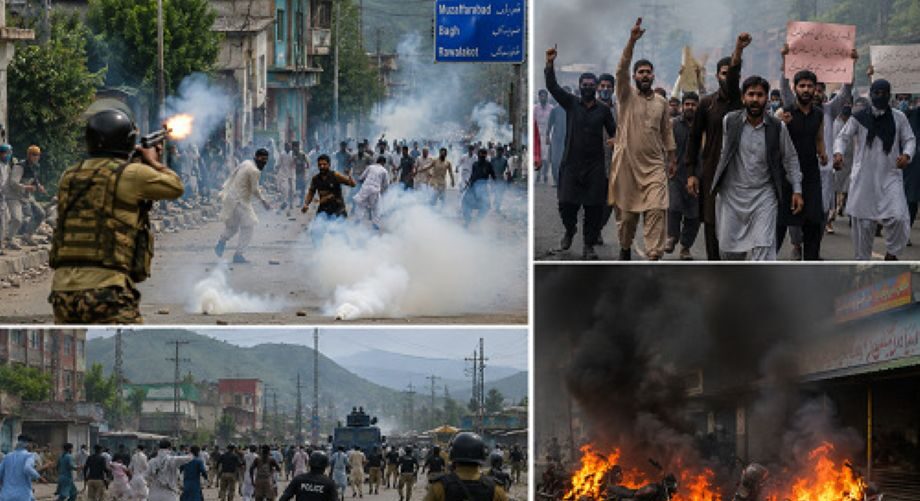
Pakistani forces opened live fire and deployed tear gas against unarmed civilians in Bagh district of Pakistan-occupied Jammu and Kashmir on August 4, according to the Joint Awami Action Committee (JAAC). The group alleged the incidents on social media while sharing ground footage of the violence.
JAAC also reported that Pakistani forces set civilians’ motorcycles ablaze in the Makri region of Muzaffarabad district. These incidents form part of a broader escalation of state brutality across PoJK, where over 50 people have been killed and hundreds injured in recent days.
The violence underscores deepening instability in Pakistan-administered Kashmir, where civilian resistance movements have intensified against Pakistani military and paramilitary operations. PoJK remains a contested territory under UN resolutions, with India maintaining its position that the entire state of Jammu and Kashmir is an integral part of the Indian Union.
Civil unrest in PoJK has periodically flared since Pakistan’s partition of the territory in 1947. The region operates under Pakistan’s direct administrative control following the ceasefire agreement in 1949, with the UN Military Observer Group in India and Pakistan (UNMOGIP) tasked with monitoring the Line of Control.
India’s Ministry of External Affairs has historically raised concerns about human rights violations in PoJK, particularly during periods of heightened military operations. The Indian government maintains that Pakistan’s occupation of the region violates international law and that the territory should be administered under Indian sovereignty as per the 1948 UN Security Council resolution.
Civilian casualties in PoJK have drawn attention from international human rights organisations, which have documented alleged extrajudicial actions, arbitrary detention, and use of force by Pakistani security forces. The current escalation marks another chapter in the long-standing disputes over Kashmir’s political status and governance.
India continues to monitor developments in PoJK through diplomatic channels and intelligence assessments, while maintaining its defence posture along the Line of Control through regular air force patrols, ground force deployments, and surveillance operations. The Indian Air Force routinely conducts combat air patrols over Jammu and Kashmir airspace to monitor cross-border activities and ensure territorial security.