


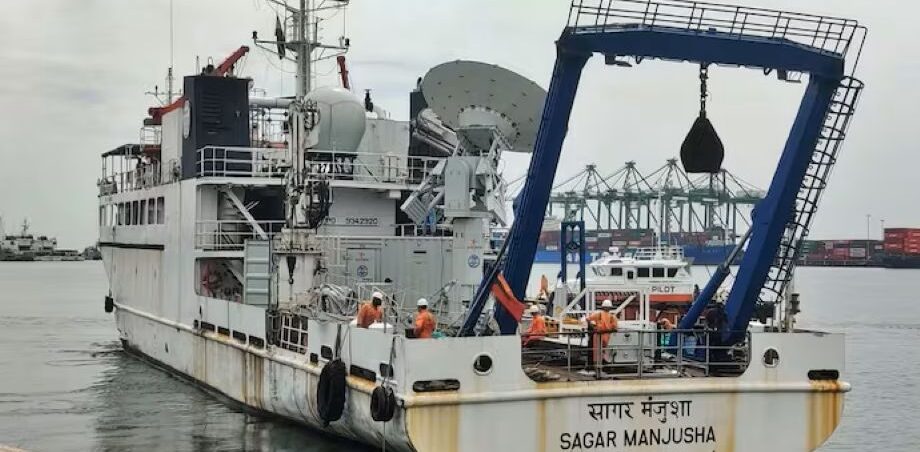
India has taken another major step towards strengthening its space capabilities as the Indian Space Research Organisation (ISRO) successfully validated its indigenous Ship-Borne Tracking Terminal (SBT) during a sea trial. The successful demonstration is expected to significantly enhance the country’s ability to monitor launch vehicles and spacecraft over oceanic regions while providing crucial support for the upcoming Gaganyaan human spaceflight mission and future satellite launches.
The validation exercise was carried out aboard the National Institute of Ocean Technology’s (NIOT) research vessel Sagar Manusha off the coast of Chennai. During the trial, the tracking terminal successfully operated under challenging maritime conditions, proving its capability to deliver reliable telemetry, communication, and tracking services from a moving platform at sea.
One of the biggest challenges during rocket launches is maintaining uninterrupted tracking once the launch vehicle moves beyond the range of land-based stations and travels over vast stretches of ocean. The newly developed indigenous Ship-Borne Tracking Terminal is designed to overcome this limitation by providing continuous monitoring during critical phases of flight. This enables mission controllers to receive real-time telemetry and tracking data throughout the mission, improving operational efficiency, mission safety, and overall reliability.
The successful validation is particularly significant for Gaganyaan, India’s first crewed space mission. Human spaceflight demands continuous communication and accurate tracking of both the launch vehicle and the crew module, especially when they pass over remote oceanic regions. The new ship-borne tracking capability will help ISRO maintain uninterrupted contact with the spacecraft, strengthening mission control and enhancing crew safety during future missions.
Beyond Gaganyaan, the indigenous maritime tracking system will support a broad range of ISRO’s upcoming satellite launches, launch vehicle missions, and deep-space exploration programmes. The achievement reflects India’s growing expertise in developing advanced space-support technologies under the country’s self-reliance initiative and further strengthens ISRO’s mission infrastructure as preparations continue for more ambitious space missions in the coming years.