


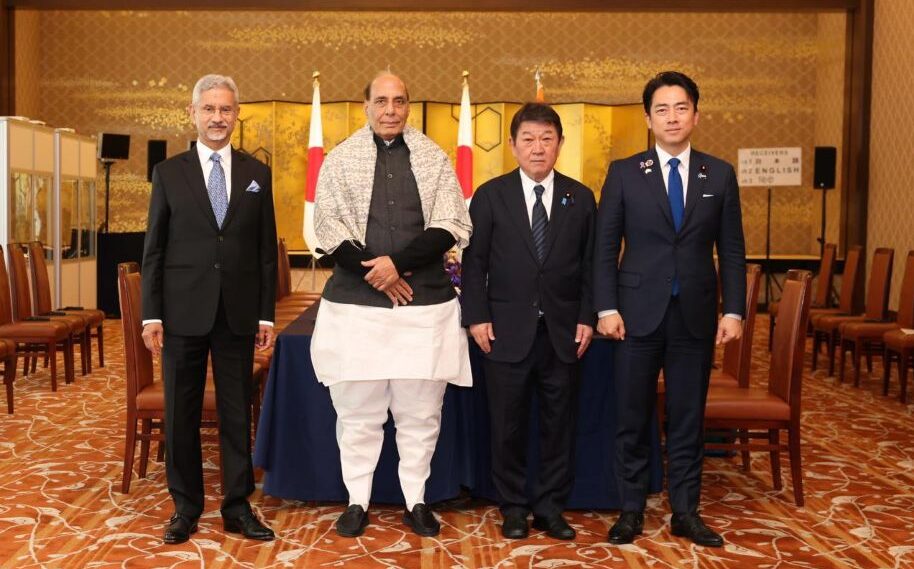
India and Japan have taken another significant step towards strengthening their strategic defence partnership following the fourth India-Japan 2+2 Foreign and Defence Ministerial Meeting held in Tokyo on November 19, 2026. The discussions focused on expanding military cooperation, defence technology development, maritime security and strengthening industrial collaboration amid growing strategic challenges in the Indo-Pacific region.
The meeting was attended by India’s Defence Minister Rajnath Singh and External Affairs Minister S. Jaishankar, along with Japan’s Defence Minister Shinjiro Koizumi and Foreign Minister Toshimitsu Motegi. Both sides reaffirmed their commitment to a free, open and stable Indo-Pacific and agreed to accelerate practical defence cooperation between their armed forces.
One of the major outcomes was the signing of a Letter of Intent (LOI) to facilitate the use of Indian firing ranges by Japan’s Self-Defence Forces. Under the proposed arrangement, Japanese military personnel will be able to conduct live-fire training in India for the first time, including exercises involving surface-to-ship missiles. Both countries agreed to speed up the necessary coordination to implement the arrangement.
The ministers also welcomed the growing scope of bilateral military exercises, particularly following the participation of Japanese Air Self-Defence Force fighter aircraft in India’s Veer Guardian 26 air exercise. They agreed to make future joint drills more complex, integrate unmanned systems and explore conducting bilateral and multilateral exercises at short notice. Cooperation in air domain awareness was also identified as an important area for further development.
Defence industrial cooperation received considerable attention during the discussions. India and Japan expressed their commitment to advancing defence manufacturing under the framework of “Design with Japan, Make in India”. Both sides also discussed accelerating arrangements related to Japan’s Unified Complex Radio Antenna (UNICORN) system, an integrated antenna mast technology intended for naval platforms. India is expected to pursue the Acceptance of Necessity (AoN) for the project by February 2027.
Another important area involves collaboration between India’s Defence Research and Development Organisation (DRDO) and Japan’s Acquisition, Technology and Logistics Agency (ATLA). The two countries agreed to advance defence research and development cooperation in advanced missile and defence technologies, creating opportunities for technological collaboration.
Maritime security was another major focus, with both countries looking to strengthen cooperation between the Indian Navy and Japan Maritime Self-Defence Force. Proposed areas include maritime and air domain awareness, information sharing, search and rescue operations, mine countermeasure capabilities and possible joint development in naval shipbuilding and design.
The ministers also welcomed the recent Malabar 2026 naval exercise involving India, Japan, the United States and Australia, along with the Japan-India Maritime Exercise JAIMEX 26. These activities reflect the growing operational coordination between the two countries and their partners.
The latest agreements demonstrate the increasing importance of India-Japan defence cooperation in the Indo-Pacific. By combining military exercises, advanced technology development, defence manufacturing and maritime security initiatives, both nations are seeking to build a more capable and resilient strategic partnership.